

Maggiori informazioni sul libro
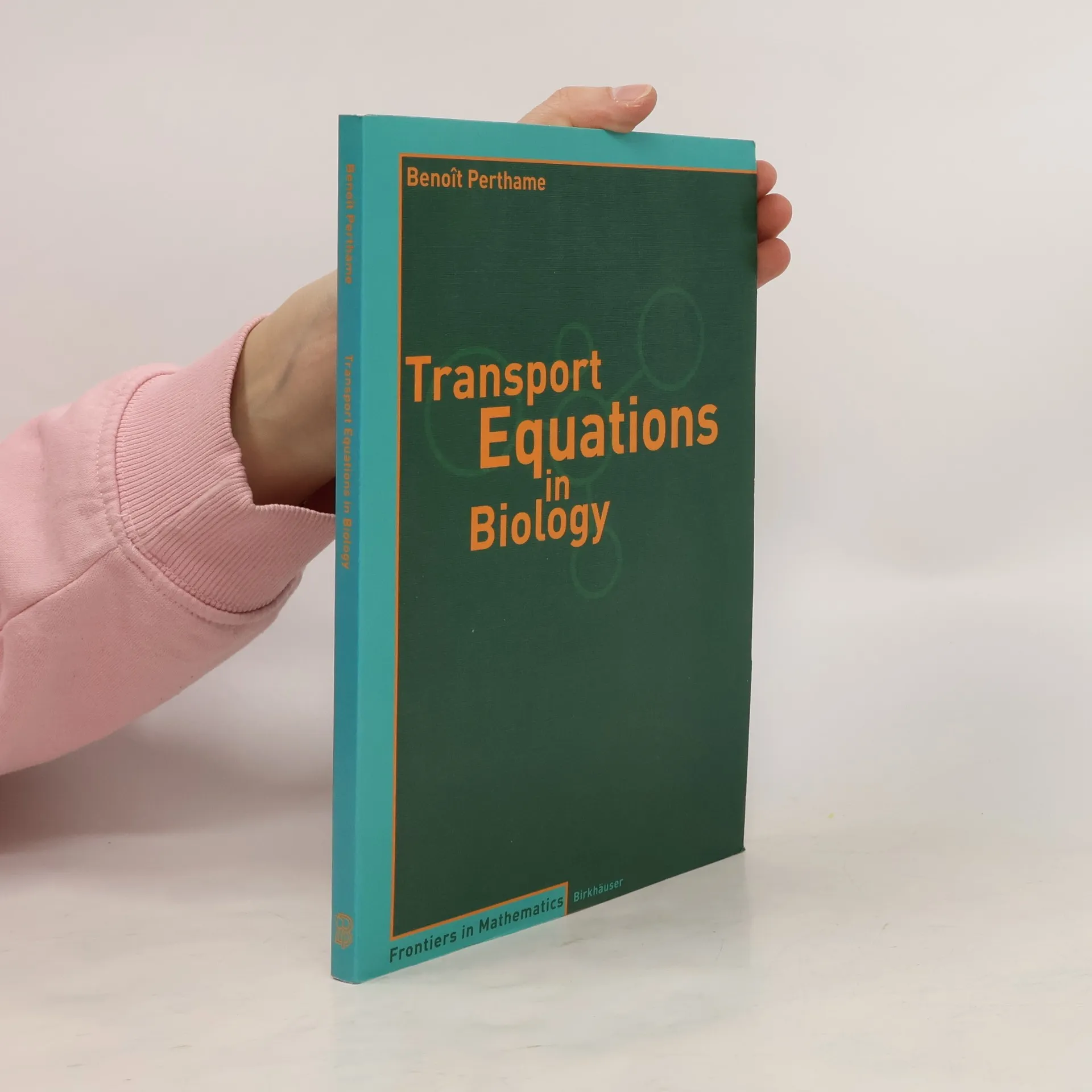
"This book presents models written as partial differential equations and originating from various questions in population biology, such as physiologically structured equations, adaptive dynamics, and bacterial movement. Its purpose is to derive appropriate mathematical tools and qualitative properties of the solutions (long time behavior, concentration phenomena, asymptotic behavior, regularizing effects, blow-up or dispersion). Original mathematical methods described are, among others, the generalized relative entropy method - a unique method to tackle most of the problems in population biology, the description of Dirac concentration effects using a new type of Hamilton-Jacobi equations, and a general point of view on chemotaxis including various scales of description leading to kinetic, parabolic or hyperbolic equations."--Jacket
Acquisto del libro
Transport equations in biology, Benoît Perthame
- Lingua

- Pubblicato
- 2007
- Rilegatura
- (In brossura)
Metodi di pagamento
Qui potrebbe esserci la tua recensione.
- Titolo
- Transport equations in biology
- Lingua
- Inglese
- Autori
- Benoît Perthame
- Editore
- Birkhäuser
- Pubblicato
- 2007
- Formato
- In brossura
- Pagine
- 198
- ISBN10
- 3764378417
- ISBN13
- 9783764378417
- Serie
- Valutazione
- 4 su 5
- Descrizione
- "This book presents models written as partial differential equations and originating from various questions in population biology, such as physiologically structured equations, adaptive dynamics, and bacterial movement. Its purpose is to derive appropriate mathematical tools and qualitative properties of the solutions (long time behavior, concentration phenomena, asymptotic behavior, regularizing effects, blow-up or dispersion). Original mathematical methods described are, among others, the generalized relative entropy method - a unique method to tackle most of the problems in population biology, the description of Dirac concentration effects using a new type of Hamilton-Jacobi equations, and a general point of view on chemotaxis including various scales of description leading to kinetic, parabolic or hyperbolic equations."--Jacket