

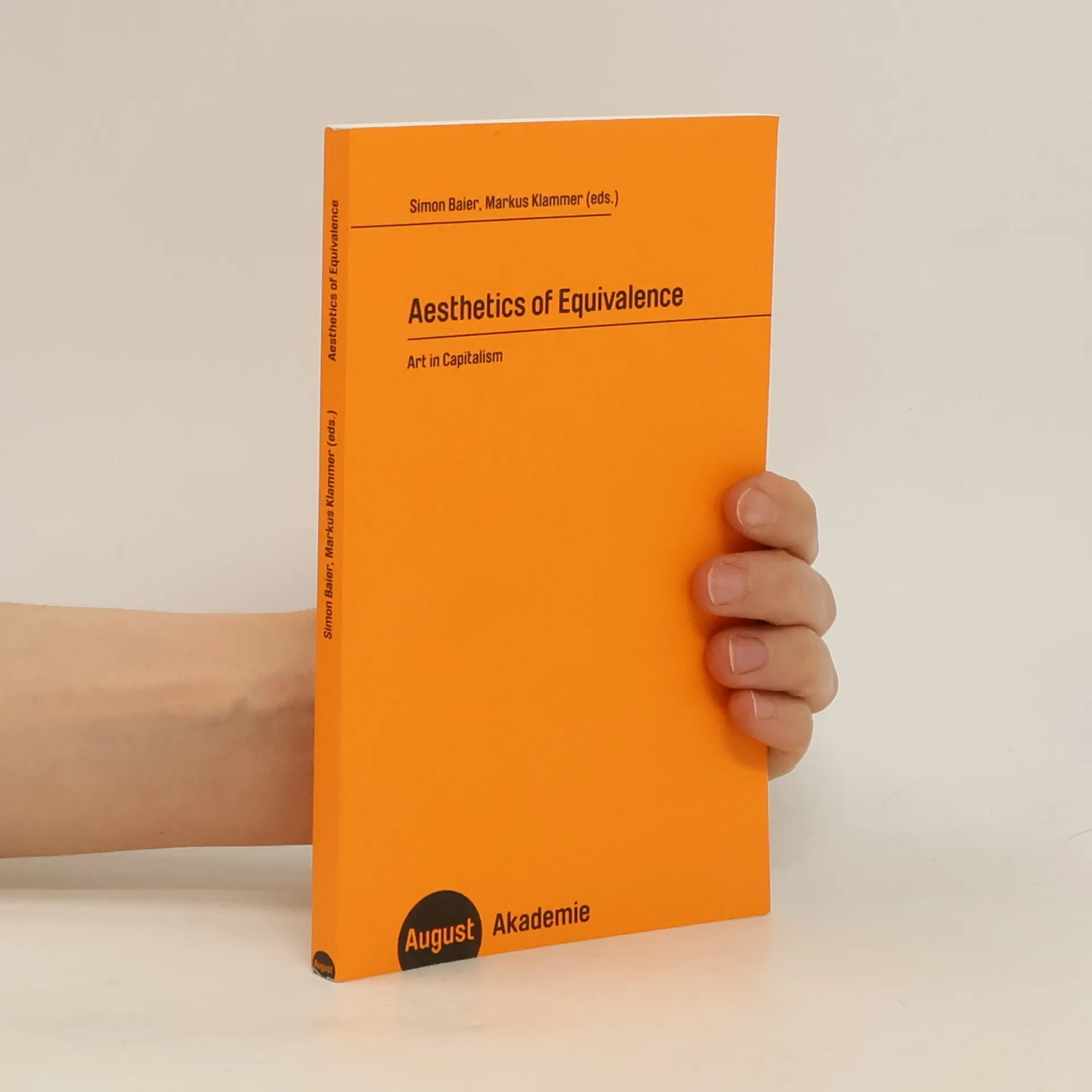


Aesthetics of Equivalence
Art in Capitalism
Autori
Parametri
Maggiori informazioni sul libro
The volume considers the relationship between contemporary art and the economy from art theoretical and philosophical perspectives. The eponymous term »equivalence« draws on three main sources: firstly, it refers to the 18th-century notion of the aesthetic and the arts as a social field in which the equality of people is not simply a postulate but can be directly felt and perceived; secondly, it builds on the Marxian definition of the »equivalent form« as universal exchangeability of commodities according to a purely quantitative principle; the third aspect of »equivalence« significant for the book concerns media and infrastructures enabling the digital and physical replication and circulation of images and objects. With regard to particular artworks, the volume’s focus is not on content-driven approaches dealing with the flux of goods, information, individuals and capital in a documentary way. Rather, the publication focuses on works whose materiality, form and structure highlight the changed technological, economic and social conditions of art production and reception in an economic field.
Acquisto del libro
Aesthetics of Equivalence, Simon Baier
- Lingua

- Pubblicato
- 2023
Metodi di pagamento
Ancora nessuna valutazione.
- Titolo
- Aesthetics of Equivalence
- Sottotitolo
- Art in Capitalism
- Lingua
- Inglese
- Autori
- Simon Baier
- Editore
- August Verlag
- Pubblicato
- 2023
- ISBN10
- 375189019X
- ISBN13
- 9783751890199
- Serie
- Categoria
- Tag
- Descrizione
- The volume considers the relationship between contemporary art and the economy from art theoretical and philosophical perspectives. The eponymous term »equivalence« draws on three main sources: firstly, it refers to the 18th-century notion of the aesthetic and the arts as a social field in which the equality of people is not simply a postulate but can be directly felt and perceived; secondly, it builds on the Marxian definition of the »equivalent form« as universal exchangeability of commodities according to a purely quantitative principle; the third aspect of »equivalence« significant for the book concerns media and infrastructures enabling the digital and physical replication and circulation of images and objects. With regard to particular artworks, the volume’s focus is not on content-driven approaches dealing with the flux of goods, information, individuals and capital in a documentary way. Rather, the publication focuses on works whose materiality, form and structure highlight the changed technological, economic and social conditions of art production and reception in an economic field.