



Maggiori informazioni sul libro
Many problems in number theory have simple statements, but their solutions require a deep understanding of algebra, algebraic geometry, complex analysis, and group representations. This book serves as an introduction to these problems and an overview of the theories currently used to address them, ensuring that number theory remains central to the discussion. It offers a survey of elliptic curves, modular forms, and $L$-functions, aiming to highlight the surprising connections among these mathematical objects and their significance in number theory. Notably, it covers the modularity theorem and its famous consequence, Fermat's Last Theorem, along with the Birch and Swinnerton-Dyer Conjecture and other modern conjectures. Beginning with motivating problems, the text includes numerous concrete examples, often involving actual numbers. While the theories of elliptic curves, modular forms, and $L$-functions are extensive and their proofs are beyond the undergraduate curriculum, the primary objects of study and the statements of key theorems and conjectures are accessible to advanced undergraduates. The focus is on motivating definitions, explaining theorems, making connections, and providing examples, rather than on complex proofs. The book aims to inspire students to delve deeper into the beauty of elliptic curves and modular forms.
Acquisto del libro
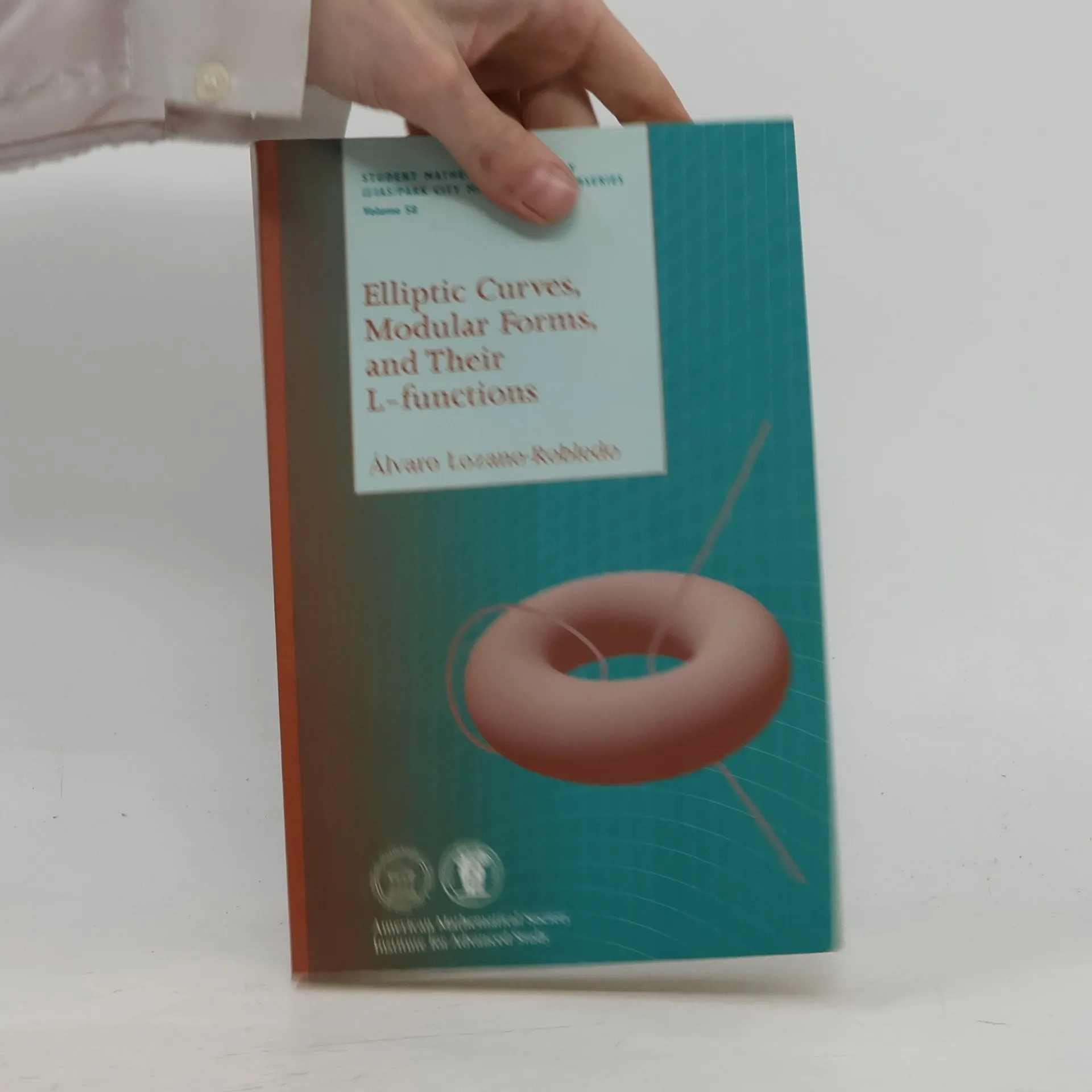
Student Mathematical Library - 52: Elliptic Curves, Modular Forms, and Their L-functions, Álvaro Lozano-Robledo
- Lingua

- Pubblicato
- 2011
- Rilegatura
- (In brossura)
Metodi di pagamento
Ancora nessuna valutazione.
- Titolo
- Student Mathematical Library - 52: Elliptic Curves, Modular Forms, and Their L-functions
- Lingua
- Inglese
- Autori
- Álvaro Lozano-Robledo
- Pubblicato
- 2011
- Formato
- In brossura
- Pagine
- 195
- ISBN10
- 0821852426
- ISBN13
- 9780821852422
- Serie
- Descrizione
- Many problems in number theory have simple statements, but their solutions require a deep understanding of algebra, algebraic geometry, complex analysis, and group representations. This book serves as an introduction to these problems and an overview of the theories currently used to address them, ensuring that number theory remains central to the discussion. It offers a survey of elliptic curves, modular forms, and $L$-functions, aiming to highlight the surprising connections among these mathematical objects and their significance in number theory. Notably, it covers the modularity theorem and its famous consequence, Fermat's Last Theorem, along with the Birch and Swinnerton-Dyer Conjecture and other modern conjectures. Beginning with motivating problems, the text includes numerous concrete examples, often involving actual numbers. While the theories of elliptic curves, modular forms, and $L$-functions are extensive and their proofs are beyond the undergraduate curriculum, the primary objects of study and the statements of key theorems and conjectures are accessible to advanced undergraduates. The focus is on motivating definitions, explaining theorems, making connections, and providing examples, rather than on complex proofs. The book aims to inspire students to delve deeper into the beauty of elliptic curves and modular forms.