

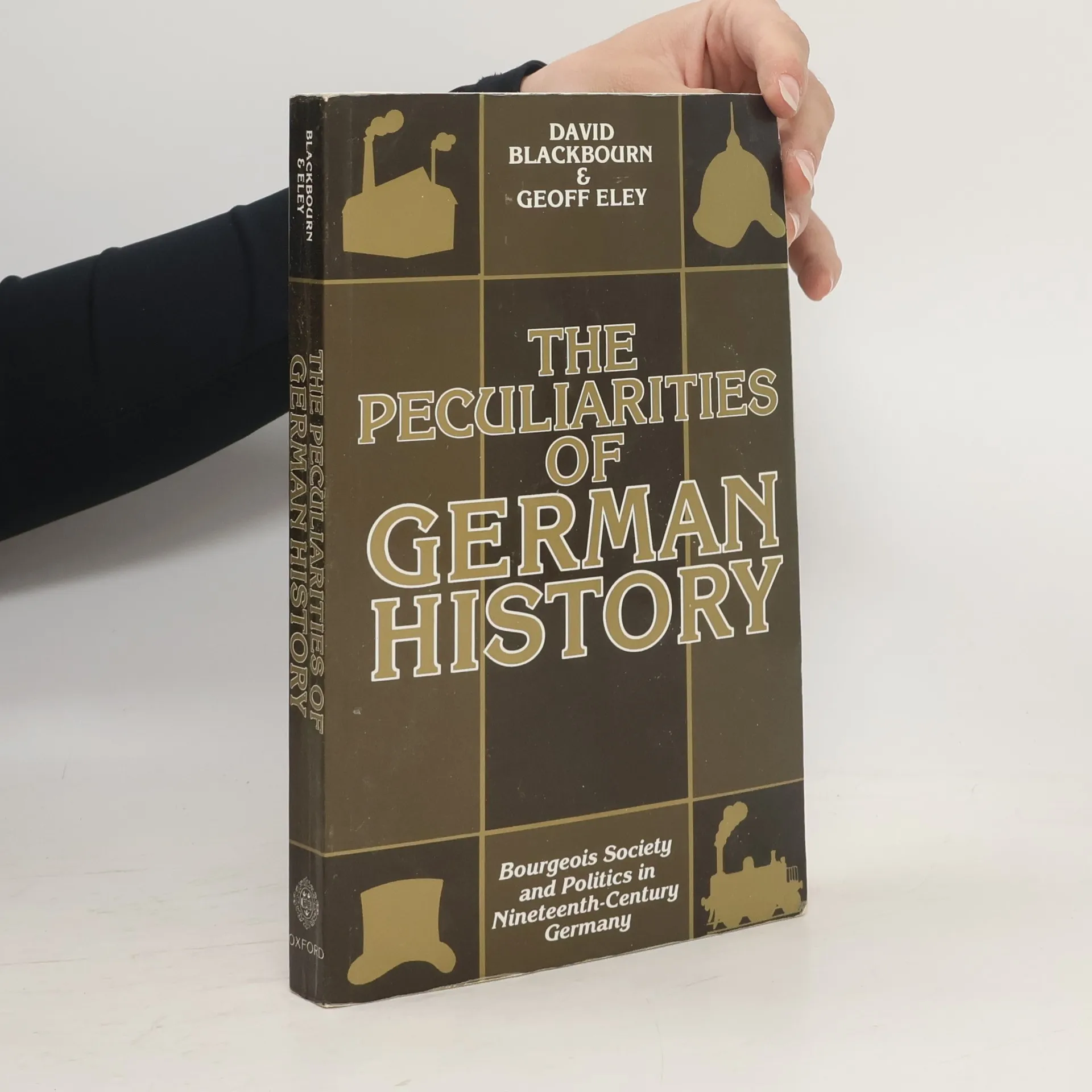
"A well-written, stimulating. . . piece of scholarship." -German Studies Review. In a major re-evaluation of the cultural, political, and sociological assumptions about the "peculiar" course of modern German history, the authors challenge the widely-held belief that Germany did not have a Western-style bourgeois revolution. Contending that it did indeed experience one, but that this had little to do with the mythical rising of the middle class, the authors provide a new context for viewing the tensions and instability of 19th-and early 20th-century Germany.
Geoff Eley Libri
Geoff Eley è uno storico di origine britannica il cui lavoro si addentra nelle complessità della storia tedesca. Esamina meticolosamente le forze sociali e politiche che hanno plasmato la nazione, offrendo ai lettori una comprensione sfumata del suo passato. L'approccio di Eley è caratterizzato dalla sua profondità e rigore intellettuale, fornendo prospettive illuminanti su periodi e movimenti cruciali nella storia tedesca. La sua erudizione è essenziale per comprendere l'evoluzione della Germania moderna.
Becoming National
- 528pagine
- 19 ore di lettura
In Becoming National Geoff Eley and Ronald Grigor Suny, two of the foremost authorities on nationalism, acknowledge these changes by combining a diverse selection of readings with a unifying introduction and instructive headnotes that move the discussion of nationalism onto a new and contemporary level. Each group of readings is introduced by a brief historical essay, and the readings are fully annotated. Emphasizing the recent intellectual advances and influential ideas of Miroslav Hroch, Benedict Anderson, Paul Gilroy, Stuart Hall, Lauren Berlant and a host of others, this book underscores the nineteenth and twentieth century nationalist theories to show not only where scholars of nationalism have been but where they are going.
Society, Culture, and the State in Germany 1870-1930
- 522pagine
- 19 ore di lettura
Society, Culture, and the State in Germany, 1870-1930 draws together important new work on the Kaiserreich - the period between Bismarck's unification of Germany and the First World War. During the 1970s and 1980s, a series of inspiring but divisive controversies called into question the ways in which German historical development in the nineteenth and twentieth centuries was mainly understood. These discussions focused on issues of continuity between Bismarck and Hitler and the peculiar strength of authoritarianism in German political culture, raising important questions about the deep origins of Nazism and about Germany's alleged differences from the West. This collection purposefully brings certain issues and approaches into the foreground. These include the value of taking gender seriously as a priority of historical work; the emergence of social policy and welfare during the early twentieth century; religious belief and affiliation as a neglected dimension in modern German history; the tremendous importance of the First World War as a climacteric; and the exciting potentials of cultural studies and the new cultural history.
Wilhelminismus, Nationalismus, Faschismus
- 331pagine
- 12 ore di lettura
Mythen deutscher Geschichtsschreibung
Die gescheiterte bürgerliche Revolution von 1848