

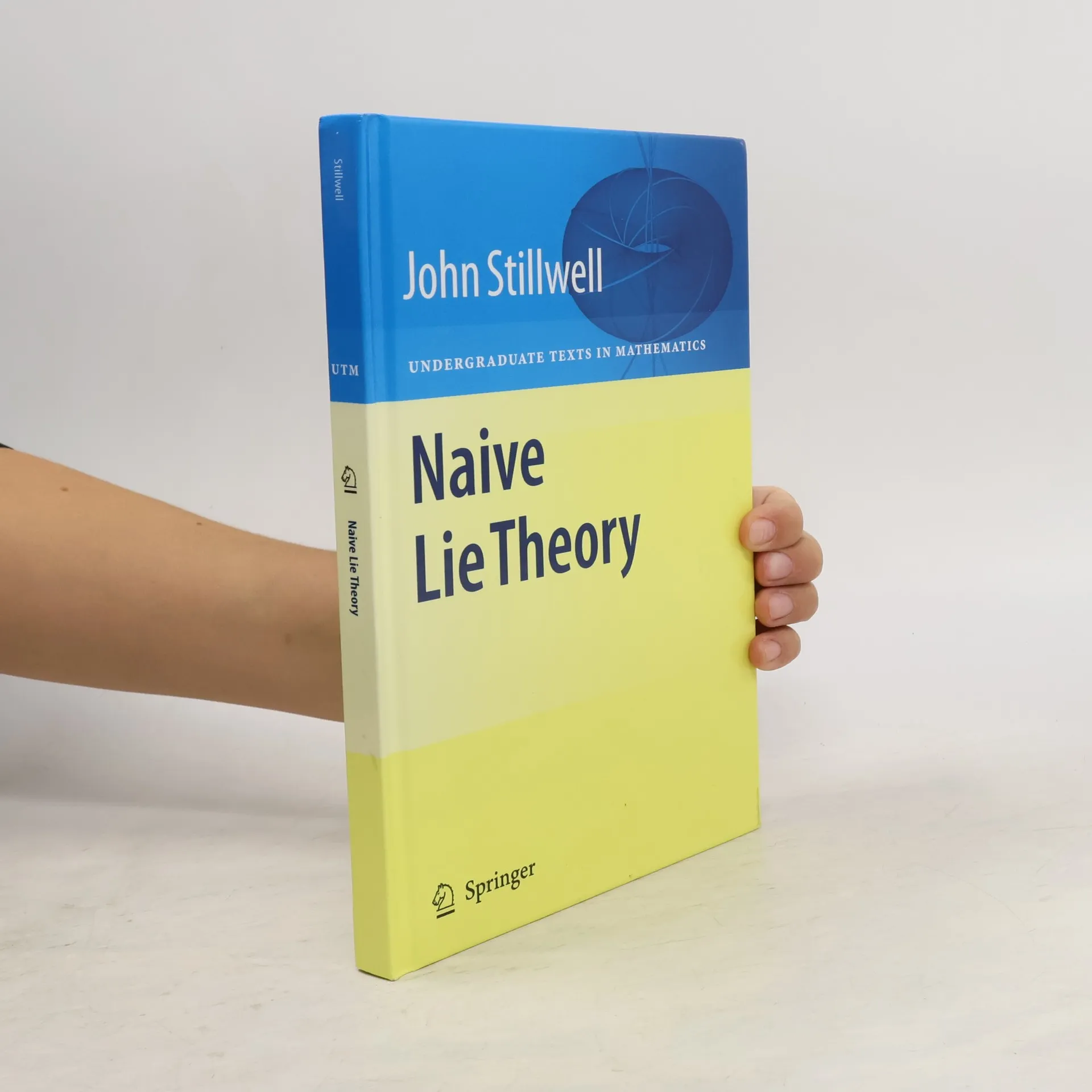
Maggiori informazioni sul libro
In this new textbook, acclaimed author John Stillwell presents a lucid introduction to Lie theory suitable for junior and senior level undergraduates. In order to achieve this, he focuses on the so-called "classical groups'' that capture the symmetries of real, complex, and quaternion spaces. These symmetry groups may be represented by matrices, which allows them to be studied by elementary methods from calculus and linear algebra. This naive approach to Lie theory is originally due to von Neumann, and it is now possible to streamline it by using standard results of undergraduate mathematics. To compensate for the limitations of the naive approach, end of chapter discussions introduce important results beyond those proved in the book, as part of an informal sketch of Lie theory and its history. John Stillwell is Professor of Mathematics at the University of San Francisco. He is the author of several highly regarded books published by Springer, including The Four Pillars of Geometry (2005), Elements of Number Theory (2003), Mathematics and Its History (Second Edition, 2002), Numbers and Geometry (1998) and Elements of Algebra (1994).
Acquisto del libro
Naive Lie Theory, John Stillwell
- Lingua

- Pubblicato
- 2008
- Rilegatura
- (Copertina rigida)
Metodi di pagamento
Qui potrebbe esserci la tua recensione.
- Titolo
- Naive Lie Theory
- Lingua
- Inglese
- Autori
- John Stillwell
- Editore
- Springer
- Pubblicato
- 2008
- Formato
- Copertina rigida
- Pagine
- 217
- ISBN10
- 0387782141
- ISBN13
- 9780387782140
- Serie
- Categoria
- Valutazione
- 4,4 su 5
- Descrizione
- In this new textbook, acclaimed author John Stillwell presents a lucid introduction to Lie theory suitable for junior and senior level undergraduates. In order to achieve this, he focuses on the so-called "classical groups'' that capture the symmetries of real, complex, and quaternion spaces. These symmetry groups may be represented by matrices, which allows them to be studied by elementary methods from calculus and linear algebra. This naive approach to Lie theory is originally due to von Neumann, and it is now possible to streamline it by using standard results of undergraduate mathematics. To compensate for the limitations of the naive approach, end of chapter discussions introduce important results beyond those proved in the book, as part of an informal sketch of Lie theory and its history. John Stillwell is Professor of Mathematics at the University of San Francisco. He is the author of several highly regarded books published by Springer, including The Four Pillars of Geometry (2005), Elements of Number Theory (2003), Mathematics and Its History (Second Edition, 2002), Numbers and Geometry (1998) and Elements of Algebra (1994).