
"In the fall of 1962, at the height of the Cold War, officers representing the three main military services, the Army, the Navy, and the Air Force, arrived at the Smithsonian Institution, in Washington. The officers were from the Desert Test Center, a new military installation in Fort Douglas, Utah. The chapter describes how these officers outlined a biological survey of various Pacific islands that they wanted to be undertaken. They were not forthcoming with their motives in wanting the survey, but Smithsonian officials volunteered to perform the survey using their own scientists and others to be hired as needed"--
Edward Regis Ordine dei libri (cronologico)


Regenesis : how synthetic biology will reinvent nature and ourselves
- 304pagine
- 11 ore di lettura
A Harvard biologist and master inventor explores how new biotechnologies will enable us to bring species back from the dead, unlock vast supplies of renewable energy, and extend human life. In Regenesis, George Church and science writer Ed Regis explore the possibilities of the emerging field of synthetic biology. Synthetic biology, in which living organisms are selectively altered by modifying substantial portions of their genomes, allows for the creation of entirely new species of organisms. These technologies-far from the out-of-control nightmare depicted in science fiction-have the power to improve human and animal health, increase our intelligence, enhance our memory, and even extend our life span. A breathtaking look at the potential of this world-changing technology, Regenesis is nothing less than a guide to the future of life.
Virus zona zero
- 240pagine
- 9 ore di lettura
Im Herbst 1983 besuchte ich zum ersten Mal das Institute for Advanced Study in Princeton, um einen Zeitschriftenartikel zu recherchieren. Bis dahin kannte ich nur den guten Ruf des Instituts und wusste, dass Einstein und Gödel dort einen Großteil ihrer wissenschaftlichen Laufbahn verbracht hatten. Wie vielen anderen wissenschaftlich interessierten Laien hatten mir Bilder von Einsteins altem Arbeitszimmer, die nach seinem Tod 1955 aufgenommen wurden, großen Eindruck hinterlassen. Diese berühmten Fotos zeigen eine mit Gleichungen vollgeschriebene Wandtafel, einen leeren, zur Seite gedrehten Stuhl und Regale voller zufällig angeordneter Bücher. Besonders beeindruckte mich das Durcheinander auf dem Schreibtisch: Sonderdrucke, Zeitschriften, Manuskripte, ein Tintenfaß, eine Pfeife und ein Tabakstopf – alles ein Hauch unvollendeter, weltumfassender Tätigkeit. Ich fragte mich, welche unentdeckten Geheimnisse sich in dieser Unordnung verbergen mochten. Auch das Bild eines anderen Wissenschaftlers, der in der Mathematikbibliothek des Instituts fotografiert wurde, blieb mir in Erinnerung. Seine hagere Gestalt mit einem dunklen Streifen über dem grauen Haar erinnerte an einen Mohawk-Indianer.
Wie zit er op Einstein's stoel?
Over genieën en zonderlingen in een ivoren toren
- 319pagine
- 12 ore di lettura
De geschiedenis van het Institute for Advanced Study in Princeton (USA), waar tientallen belangrijke wetenschappers als Einstein, Gödel en Oppenheimer hun werk deden. Daarbij wordt aandacht besteed aan hun leven, hun onderzoek en hun karakters.
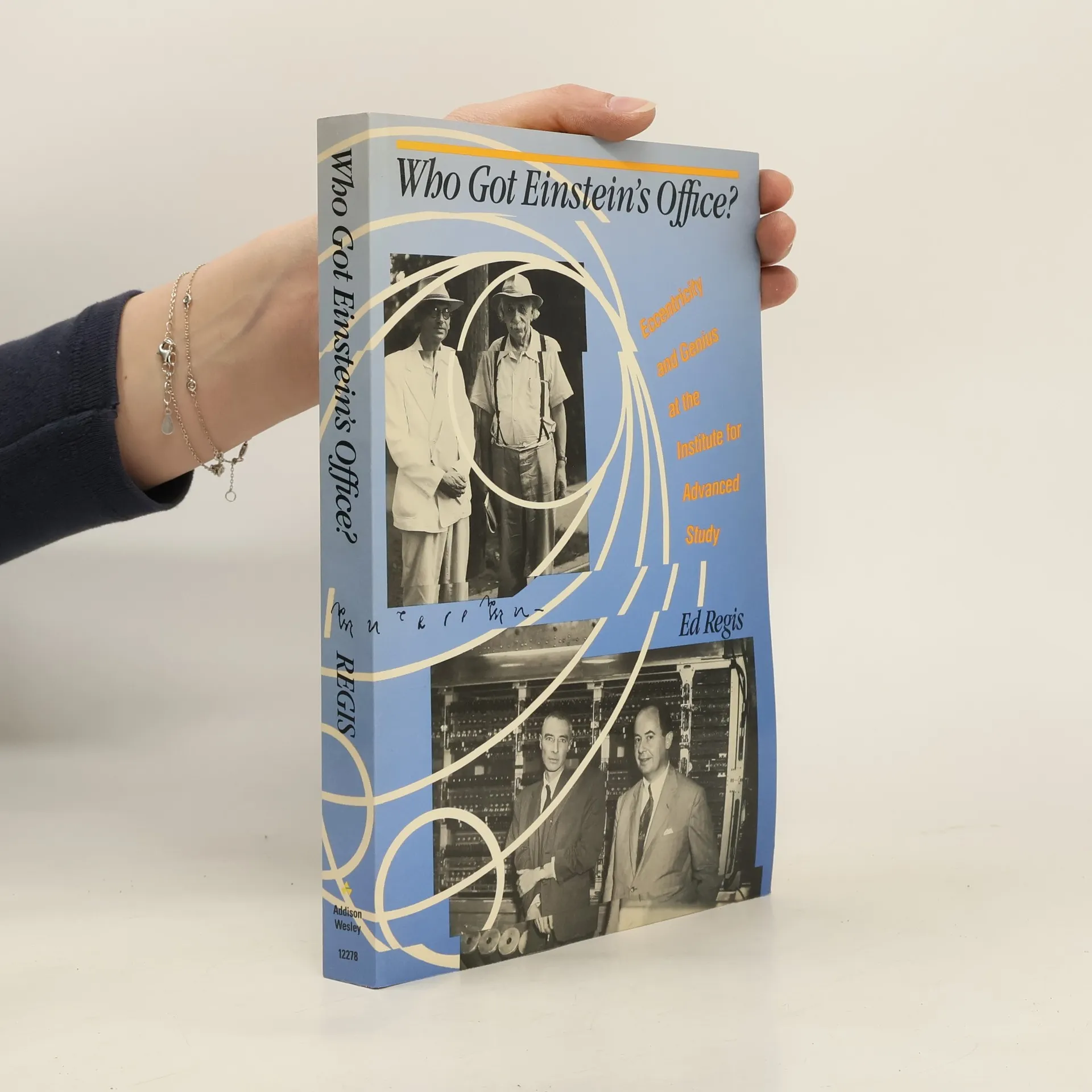
Who Got Einstein's Office?
- 336pagine
- 12 ore di lettura
It was home to Einstein in decline, the place where Kurt Göedel starved himself in paranoid delusion, and where J. Robert Oppenheimer rode out his political persecution in the Director's mansion. It is the Institute for Advanced Study in Princeton, New Jersey; at one time or another, home to fourteen Nobel laureates, most of the great physicists and mathematicians of the modern era, and two of the most exciting developments in twentieth-century science—cellular automata and superstrings. Who Got Einstein's Office? tells for the first time the story of this secretive institution and of its fascinating personalities.