L' ipocondria dell'impolitico
- 524pagine
- 19 ore di lettura


Domenico Losurdo è stato un filosofo e storico marxista italiano, noto per la sua critica all'anticomunismo, al colonialismo e all'imperialismo. Ha esplorato la tradizione europea del liberalismo e il concetto di totalitarismo, offrendo nuove prospettive su indagini politiche e filosofiche cruciali. Le sue analisi attingevano spesso da uno studio approfondito del pensiero dialettico, che collegava Hegel e Marx. Gli scritti di Losurdo rappresentano quindi un contributo significativo alla comprensione delle ideologie politiche moderne e delle loro basi storiche.


Author of the acclaimed Liberalism: A Counterhistory dissects the revisionist attempts to expunge or criminalise revolutions
The book explores two centuries of non-violence history, detailing significant crises faced by the movement. It combines historical reconstruction with philosophical and psychological insights, delving into the moral dilemmas that arise during these pivotal moments. Through this dual approach, it examines the complexities and challenges inherent in advocating for non-violence across different eras.
"In Heidegger and the Ideology of War, Domenico Losurdo reconstructs the genesis of Heidegger's philosophy in its historical context, analyzing the characteristics of the peculiar "ideology of war" developed in Germany at the outset of the First World War. In the twentieth century, conflicts between states for the first time took the form of total war, requiring the mobilization of an entire society. On the one hand, among the allied nations, this all-pervasive ideological mobilization centered on the principle of "democratic intervention," the Wilsonian idea of a holy crusade able to subvert the eternally militarist and autocratic Germany and, in this way, favor a kind of great "international democratic revolution." On the other hand, in a spiral of radicalization, the German ideology of war characterized the looming conflict as a great clash between irreconcilable civilizations, faiths, world-visions, and even races. Germans affirmed not only the superiority of their culture, but above all a political and social model that expelled from modernity every universal concept of emancipation and democratization."--Jacket
One of Europe’s leading intellectual historians deconstructs the dark side of liberalism, sifting through 3 centuries of liberal writings by John Locke, Alexis de Tocqueville, and others. In this definitive historical investigation, Italian author and philosopher Domenico Losurdo argues that from the outset liberalism, as a philosophical position and ideology, has been bound up with the most illiberal of policies: slavery, colonialism, genocide, racism and snobbery. Narrating an intellectual history running from the 18th through to the 20th centuries, Losurdo examines the thought of preeminent liberal writers such as Locke, Burke, Tocqueville, Constant, Bentham, and Sieyès, revealing the inner contradictions of an intellectual position that has exercised a formative influence on today’s politics. Among the dominant strains of liberalism, he discerns the counter-currents of more radical positions, lost in the constitution of the modern world order.
HOW AN IRON FIST DONNED DEMOCRACY'S VELVET GLOVE
There were times when renowned statesmen and intellectuals viewed Stalin and his country with respect and admiration. However, with the onset of the Cold War and Khrushchev's secret speech, Stalin became perceived as a 'monster,' comparable only to Hitler. Domenico Losurdo examines the conflicts and interests underlying this dramatic shift in perspective. He uses the stark contrast in images of Stalin as a starting point to critically analyze all representations rather than absolutizing one. To achieve this, he explores Soviet history through a comprehensive comparison of the tragedies of the 20th century, demystifying Stalin and placing many of the accusations against him in their historical context.
Available for the first time in English, this book examines and reinterprets class struggle within Marx and Engels' thought. As Losurdo argues, class struggle is often misunderstood as exclusively the struggle of the poor against the rich, of the humble against the powerful.
Translated into English for the first time, this work portrays a different side of Hegel -- not just as a philosopher preoccupied with abstract ideas but a man deeply enmeshed and active in the pressing, concrete political issues of his time
The book offers a sharp critique of Western Marxism, highlighting its alignment with imperialist ideologies. It contrasts this perspective with a growing anti-imperialist movement, arguing for a reevaluation of Marxist principles in light of contemporary global struggles. Through this analysis, the author seeks to illuminate the contradictions within Western Marxist thought and advocate for a more authentic anti-imperialist stance.
Wie er entstand, verschied und auferstehen könnte
Im Herzen des Westens geboren, verbreitete sich der Marxismus mit der Oktoberrevolution in alle Ecken der Welt und entwickelte sich je nach historischem, sozialem und wirtschaftlichem Kontext unterschiedlich und kontrastierend. Im Gegensatz zum orientalischen Marxismus verlor der westliche Marxismus den Bezug zur antikolonialen Weltrevolution – einem entscheidenden Wendepunkt des 20. Jahrhunderts – und erlitt schließlich einen Zusammenbruch. In seinem neuen Buch erzählt Domenico Losurdo die Parabel des westlichen Marxismus: seine Geburt, seine Entwicklung und seinen Fall. Eine polemische und kämpferische Arbeit, die als eine Art Abrechnung mit dem Verlauf des westlichen Marxismus betrachtet werden kann, indem sie seinen gesamten Werdegang bis zu aktuellen Figuren wie Slavoj Žižek, David Harvey, Alain Badiou, Giorgio Agamben und Antonio Negri nachzeichnet, ohne dabei klassische Denker wie Theodor W. Adorno, Max Horkheimer, György Lukács, Herbert Marcuse, Louis Althusser, Ernst Bloch und Jean-Paul Sartre zu vergessen. Losurdo diagnostiziert den "Tod" des westlichen Marxismus, zeichnet seine Genese nach und stellt entscheidende Fragen: Wäre eine Wiedergeburt heutzutage möglich? Unter welchen Bedingungen?
Triumph und Niedergang des allgemeinen Wahlrechts
Kaum war im 19. Jahrhundert gegen den Widerstand konservativer und liberaler Eliten das allgemeine Wahlrecht errungen, begann auch schon dessen Aushöhlung, um es auf bloße Akklamation der einsamen Entscheidungen eines mit allumfassender Macht ausgestatteten Führers durch eine atomisierte Masse zu reduzieren. Erstmals in Frankreich installiert, wird ein solches Regime seit Napoleon III. als Bonapartismus bezeichnet. Es hat seither einen komplexen historischen Prozess durchlaufen und inzwischen eine moderne Form angenommen. Dank des gigantischen Konzentrationsprozesses der Massenmedien beraubt ein solches System die subalternen Klassen ihrer autonomen Interessenartikulation und beschränkt die 'Demokratie' auf den Konkurrenzkampf rivalisierender Einzelpersonen, von denen sich dann eine charismatische Figur als Führer der Nation abheben kann. Die USA sind das wichtigste Experimentierfeld für diesen modernen Bonapartismus, der aber auch in Italien schon erprobt wurde und sich zur Regierungsform unserer Zeit verallgemeinern will.
Dem westlichen Sieg im Kalten Krieg folgte der Sieg des 'historischen Revisionismus' in der Geschichtsbetrachtung. Diese Strömung verbindet sich mit Namen wie François Furet, Andreas Hillgruber, Ernst Nolte oder Carl Schmitt. Sie dämonisiert die Revolution von 1789 nicht weniger als die von 1917, verklärt den 'liberalen Westen' und verdrängt dessen koloniale Tradition. Das gilt für die Gräuel an den Kolonialvölkern und die den 'minderwertigen Rassen' auferlegte Zwangsarbeit ebenso wie für den Wettlauf der kolonialen Großmächte und die beiden Weltkriege. Rätselhaft bleiben aber auch der Nazismus, der diese Tradition noch radikalisierte, und der Völkermord an den Juden, die von Hitler beschuldigt wurden, Drahtzieher der Oktoberrevolution und des antikolonialen Aufbegehrens zu sein. Indem er die koloniale Tradition zum Ausgangspunkt macht, gelingt Domenico Losurdo eine originelle Re-Interpretation der neueren Geschichte und eine prägnante Kritik von Geschichtsbild und Grundbegriffen der modernen Gegenaufklärung.
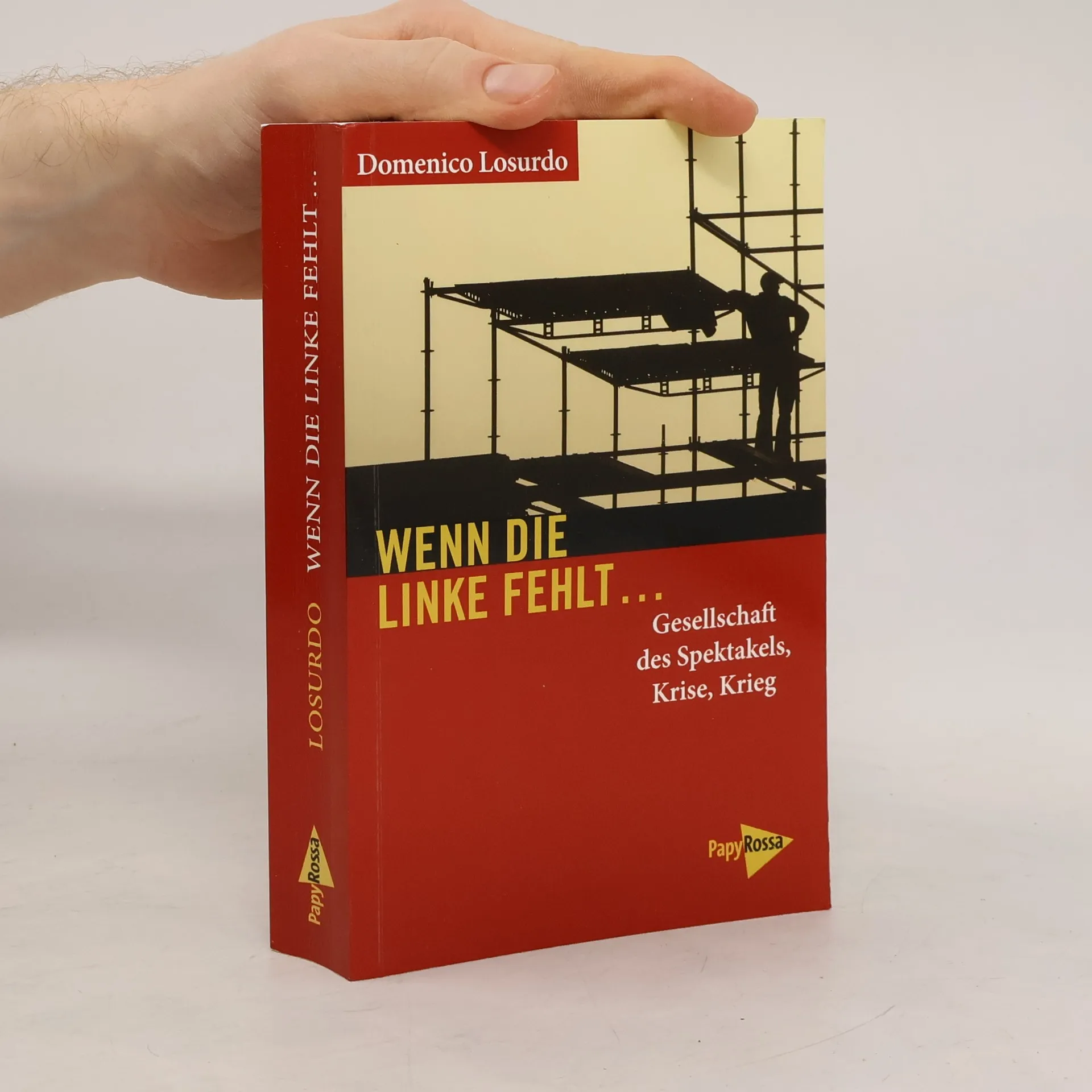
Die Versprechen des Jahres 1989 auf eine Welt im Zeichen von Wohlstand und Frieden sind nicht in Erfüllung gegangen. Die Finanzkrise vergrößert auch in entwickelten Ländern das Massenelend und verschärft die soziale Ungleichheit derart, dass es dem Großen Geld ermöglicht wird, die politischen Institutionen zu kapern. Auf internationaler Ebene folgt ein »kleiner Krieg« auf den anderen, der allerdings im jeweils betroffenen Land zehntausende Tote mit sich bringt. Darüber hinaus zeichnet sich am Horizont die Gefahr größerer Konflikte ab, die sogar die Schwelle zum Atomkrieg überschreiten könnten. Mehr denn je wird deutlich, dass eine Oppositionskraft notwendig ist: Unglücklicherweise glänzt die Linke im Westen durch Abwesenheit. Wie lässt sich das erklären? Wie die Welt verstehen, die sich da seit 1989 abzeichnet? Mit welchen Mechanismen gelingt es der »Spektakelgesellschaft«, Kriege und Kriegspolitik zu legitimieren? Wie lässt sich eine Alternative konstruieren? Auf diese Fragen antwortet der Autor mit einer originellen, unvoreingenommenen Analyse, die zur Diskussion auffordert.
Die Friedensidee von den Verheißungen der Vergangenheit bis zu den Tragödien der Gegenwart
Domenico Losurdo zeichnet eine faszinierende Geschichte der Idee des Friedens von der Aufklärung und der Französischen Revolution bis in die Gegenwart mit ihren Kriegsgefahren nach. Diese Geschichte, deren Protagonisten die großen Intellektuellen (so Kant, Fichte, Hegel, Constant, Comte, Spencer, Marx, Engels, Popper) und einflussreiche Staatsmänner (wie Washington, Robespierre, Napoleon, Wilson, Lenin, Bush Sr.) sind, führt zu den dramatischen Problemen unserer Zeit: Ist es möglich, eine Welt ohne Krieg aufzubauen? Ist die Demokratie eine echte Garantie für den Frieden oder kann sie zu einer Ideologie des Krieges werden? Wie und unter welchen Umständen kann der Universalismus in einen Anspruch auf Überlegenheit und Weltherrschaft umschlagen? Das Nachdenken über die Verheißungen, die Enttäuschungen und die Wendungen in der Geschichte der Idee des immerwährenden Friedens ist nicht nur wichtig, um die Vergangenheit zu verstehen, sondern auch, um erneut den Kampf gegen die wieder wachsende Gefährdung des Weltfriedens aufzunehmen.
Geschichte, Erbe und Zukunft
Dass die Oktoberrevolution mit ihren Folgen zu den Grundübeln des 20. Jahrhunderts gehöre, gilt häufig als selbstverständlich. Hand in Hand geht damit eine Verklärung der vorrevolutionären liberalen Gesellschaften. Zu wenig beachtet wird ihr Ausschluss der Frauen aus dem politischen Leben, ihre Einschränkung der politischen Rechte breiter Bevölkerungsmassen sowie ihr Kolonialismus und Rassismus. Unbeachtet bleibt, dass die Überwindung dieser drei großen Diskriminierungen ohne den Oktober 1917 kaum denkbar wäre. Dies rückgängig zu machen und die Rassendiskriminierung noch zu verschärfen, war das Ziel des Nazismus. In seinem Kolonialreich hatten die 'Eingeborenen' Osteuropas einerseits die Rolle der Indianer zu spielen, die es zu dezimieren galt, andererseits die der Schwarzen, die als Sklaven im Dienste der Herrenrasse arbeiten mussten. Stellt die Kategorie 'Totalitarismus' die angehenden Sklavenhalter und ihre Opfer auf eine Stufe, schweigt sie sich aus über die Gräuel der kolonialen Tradition.
Als 2006 die Fußball-WM in Deutschland stattfand, wurden Tausende deutscher Fahnen geschwenkt. Schnell waren die Rufer in der Wüste, die mit Grass riefen: „Deutschland denken heißt Auschwitz denken„ und vor einem neuen Nationalismus warnten. Domenico Losurdo, als italienischer Philosoph und Marxist eher unverdächtig, ist der dahinter stehenden Frage nachgegangen: „Ist Deutschland ein unverbesserliches Volk?“ Wer nur in Grass’scher Diktion denkt, ignoriert, dass in Geschichte und Gegenwart der Deutschen mächtige fortschrittliche Strömungen zu finden sind. Der verdrängt, dass der Faschismus keineswegs eine exklusiv deutsche Erscheinung war und ist und dass das Dritte Reich keineswegs nur deutsche Wurzeln hat. Der Knüppel vom „deutschen Sonderweg“ dient dazu, die Bundesrepublik in einer Vasallenrolle gegenüber den USA zu halten.