Erwin Schrödinger fu un fisico austriaco i cui contributi fondamentali alla teoria quantistica stabilirono la meccanica ondulatoria. Formulò l'equazione d'onda, rivelandone il ruolo fondamentale nella meccanica quantistica e la sua equivalenza con la meccanica matriciale. Schrödinger propose anche un'interpretazione innovativa del significato fisico della funzione d'onda, offrendo nuove prospettive sul regno quantistico. I suoi progressi nella teoria atomica gli valsero il Premio Nobel per la Fisica.
This volume contains new publications (typeset in LaTeX) of two essays by Schrödinger "Our Image of Matter" (1952) and "What is an Elementary Particle?" (1957) and his book Expanding Universes (1956). The collection intends to provide an idea of Schrödinger's views on the whole world - from the quantum level to the Universe. While the first two essays are written for a wider audience the third work - Expanding Universes - is more technical and would be also of interest to physicists and physics students.
This collection contains a new publication of the Heisenberg, Born, Schroedinger and Auger, On Modern Physics and the Nobel lectures of Werner Heisenberg, Erwin Schroedinger and Max Born.In this collection three Nobel laureates and a renowned authority on space exploration discuss a wide range of issues - from lessons that can be learned from the ancient Greek philosophers, to the advancements in fundamental physics in the twentieth century, to the dark implications of scientific discoveries, to the methods and limits of scientific knowledge - in a language that is understandable by a wide audience.
This is a new publication of eight of Schrödinger's "Science, Art and Play""The Law of Chance""Indeterminism In Physics""Is Science a Fashion of the Times?""Physical Science and the Temper of the Age""What is a Law of Nature?""Conceptual Models in Physics and their Philosophical Value""The Fundamental Idea of Wave Mechanics" (Schrödinger's Nobel Address delivered at Stockholm on December 12, 1933)
This is a new publication of the Collected Papers On Wave Mechanics by Erwin Schrödinger - one of the founding fathers of quantum physics.This valuable book should prove attractive to experts, students and all interested in the origin, the foundations and the philosophy of quantum physics. A particular reason for this is that Schrödinger discusses two issues which are still (in the 21st century) unsettled - the physical meaning of the wave function and the statistical nature of quantum physics. Like Einstein, Schrödinger was not satisfied with the statistical description of quantum "The question whether the solution of the difficulty is really to be found only in the purely statistical interpretation of the field theory which has been proposed in several quarters must for the present be left unsettled. Personally I no longer regard this interpretation as a finally satisfactory one, even if it proves useful in practice. To me it seems to mean a renunciation, much too fundamental in principle, of all attempt to understand the individual process."
Erwin Schrö dinger was a brilliant and charming Austrian, and one of the greatest scientists of the twentieth century. This abridgement of Walter Moore's magisterial Schrö dinger: Life and Thought offers a highly readable account, interweaving Schrö dinger's scientific work with his intense personal friendships, his interest in mysticism, and the turbulent background of political events in Europe. Hailed as a "breathtaking accomplishment," Walter Moore's colorful account is destined to become a classic of scientific biography
Nobel laureate's brilliant attempt to develop a simple, unified standard method of dealing with all cases of statistical thermodynamics — classical, quantum, Bose-Einstein, Fermi-Dirac, and more.The work also includes discussions of Nernst theorem, Planck's oscillator, fluctuations, the n-particle problem, problem of radiation, and much more.
A Nobel prize winner, a great man and a great scientist, Erwin Schrödinger
has made his mark in physics, but his eye scans a far wider horizon: here are
two stimulating and discursive essays which summarize his philosophical views
on the nature of the world.
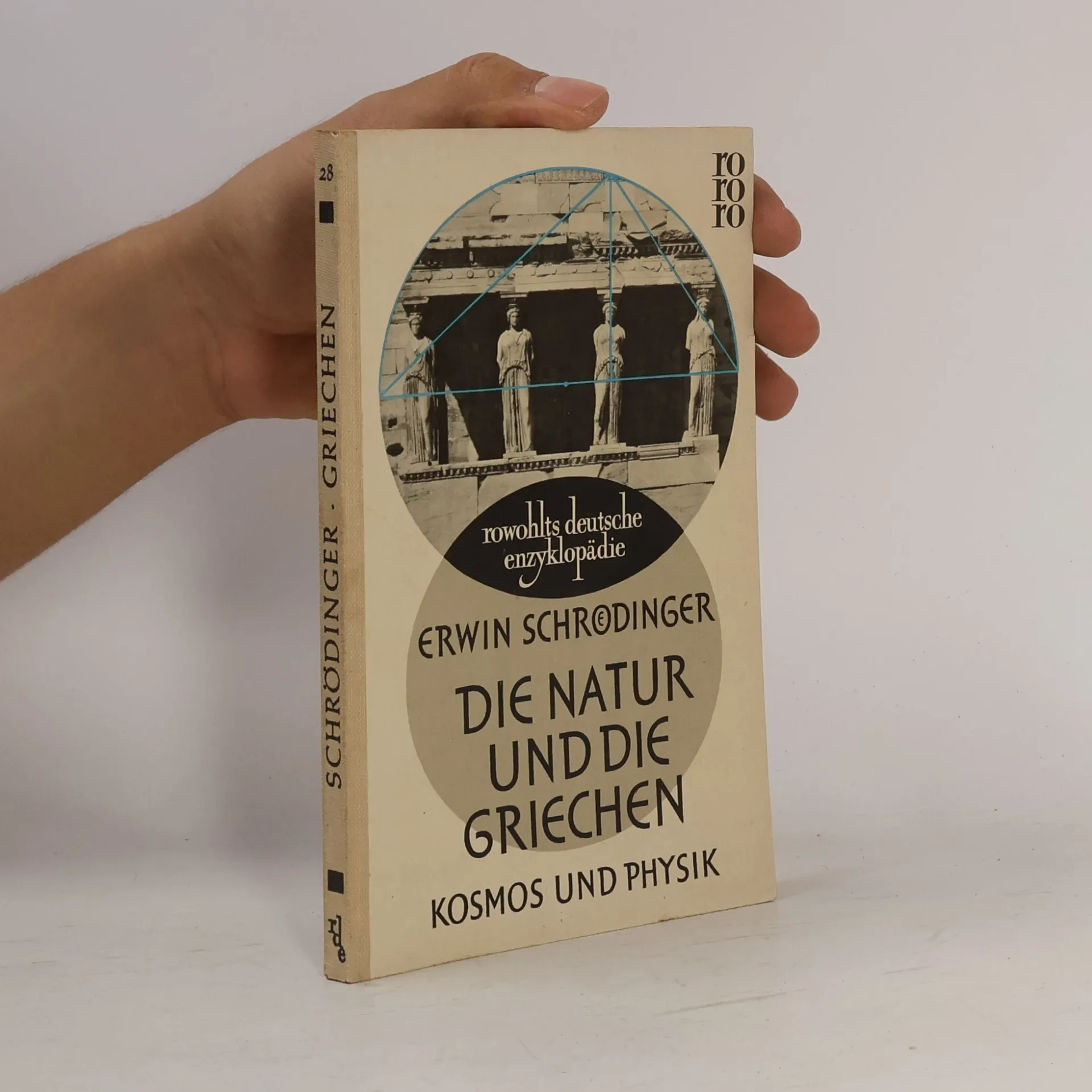
Der XX. Jahrhundert wird ohne Zweifel als eines der Perioden in die Geschichte eingehen, in dem die Menschheit die revolutionärsten wissenschaftlichen Veränderungen erlebt hat. Erwin Schrödinger, Nobelpreisträger für Physik, war, zusammen mit Einstein, einer der ersten, die zu diesen Veränderungen beigetragen haben. In seinem Kurs von 1948, der später in das Buch umgewandelt wurde, riet er seinen Schülern, ihre Aufmerksamkeit auf die Denker der Antike zu richten, trotz aller wissenschaftlichen Fortschritte, die damals bereits zur Verfügung standen. Sein Interesse an den Ursprüngen des wissenschaftlichen Denkens entspringt der Sorge, die intrinsischen Ursachen des Konflikts zwischen Religion und Wissenschaft, zwischen Philosophie und Physik zu verstehen, ein Konflikt, der sich seit der Wiedergeburt der Wissenschaft im 17. Jahrhundert bis heute verschärft hat und aus einer grundlegenden, noch ungelösten Frage hervorgeht: Woher komme ich und wohin gehe ich? Schrödinger, der in seiner eigenen Forschung zur tiefen Natur der physikalischen Realität vertieft war, wollte herausfinden, welchen Platz die Menschheit in Bezug auf diese „Realität“ hat und wie die großen Denker der Vergangenheit diese Frage untersucht haben. Wer könnte uns besser durch diese faszinierende Erkundung der Ursprünge führen, als er, als Philosophie und Wissenschaft Teil eines einzigen Denkens waren?
"What Is Life?" is Nobel laureate Erwin Schrödinger's exploration of the question which lies at the heart of biology. His essay, "Mind and Matter," investigates what place consciousness occupies in the evolution of life, and what part the state of development of the human mind plays in moral questions. "Autobiographical Sketches" offers a fascinating fragmentary account of his life as a background to his scientific writings.