

Raffaele D'Amato Ordine dei libri


- 2023
- 2023
Meticulously researched, this book examines the evidence for the post-Roman military forces of France and Britain during the 'Dark Ages', reconstructing their way of life and the battles they fought in compelling detail.The collapse of the former Western Roman Empire during the so called 'Dark Ages' c. AD 410 was gradual and piecemeal. Out of this vacuum arose regional tribes and leaders determined to take back kingdoms that were theirs and oust any Roman presence for good. However, the Roman guard was tenacious and survived in small pockets that emerged in both Gaul and Britain. These areas of Romano-Celtic resistance held out against the Saxons until at least the mid 6th century in Britain and against the Visigoths and the Merovingian Franks until the late 8th century in France.Drawing on archaeological finds, contemporary sculpture and manuscript illuminations, Dr Raffaele D'Amato presents contemporary evidence for 5th to 9th-century Gallic and British 'Dark Age' armies and reconstructs their way of life and the battles they fought. The text, accompanied by photographs and colour illustrations, paints an intricate picture of how these disparate groups of Roman soldiers survived and adapted on the fringes of the Roman Empire.
- 2022
Drawing upon the latest literary and archaeological research, this is an in-depth study of the Roman Army units based in the Eastern Provinces during the turbulent third century of the Roman Empire.In this book, eminent Roman historian, Dr Raffaele D'Amato, looks at the notoriously under-represented history of the Roman armies during the middle 3rd Century whose records have been obscured by the chaotic civil wars of that period between usurpers to the Imperial authority of Rome. Following on from the previous title , MAA 527, Roman Army Units in the Western Provinces (2): 3rd Century AD , this book considers the evidence for troops in the Eastern half of the Empire specifically around the Balkans, Mesopotamia, the Middle East and North Africa and looks at the weakness of Imperial central authority which inevitably led to local particularism and a wide range of appearance in regional commands.Dr D'Amato uses literary, painted, sculptural and archaeological sources to reconstruct this little-understood period of Roman military history and, with the aid of meticulous coloured artwork, photos and detailed charts, reconstructs the appearance and campaigns of the Roman forces stationed in the East.
- 2021
This book draws upon the latest research to explain and illustrate the Roman and allied troops of the consular armies led by Julius Caesar in his Gallic and civil wars.Caius Julius Caesar remains the most famous Roman general of all time. Although he never bore the title, historians since Suetonius have judged him to be, in practice, the very first 'emperor' – after all, no other name in history has been synonymous with a title of imperial rule. Caesar was a towering personality who, for better or worse, changed the history of Rome forever. His unscrupulous ambition was matched only by his genius as a commander and his conquest of Gaul brought Rome its first great territorial expansion outside the Mediterranean world. His charismatic leadership bounded his soldiers to him not only for expeditions 'beyond the edge of the world' – to Britain – but in the subsequent civil war that raised him to ultimate power. What is seldom appreciated, however is that the army he led was as varied and cosmopolitan as those of later centuries, and it is only recently that a wider study of a whole range of evidence has allowed a more precise picture of it to emerge. Drawing on a wide-range of new research, the authors examine the armies of Julius Caesar in detail, creating a detailed picture of how they lived and fought.
- 2020
Roman Heavy Cavalry (2)
- 64pagine
- 3 ore di lettura
In the twilight of the Western Roman Empire during the 5th-6th centuries, the elite heavy armored cavalry known as cataphracts dominated the field armies, protected by various types of armor. Following the fall of the West, the Byzantine Empire thrived for nearly a millennium, with cavalry remaining a key component of its military, particularly the heavily armored regiments that served as the ultimate shock-force in battles. Muslim chroniclers depicted these formidable cataphracts as awe-inspiring adversaries, likening them to iron-covered warriors on seemingly legless horses. The heavy cavalry included regiments from the Tagmata, the central imperial force in Constantinople, such as the Scholai, Eskoubitoi, Athanatoi, and Ikanatoi, along with provincial units drawn from the Themata districts. By the 11th century, these provincial forces began to be supplanted by mercenaries as local governors gained semi-independence and often rebelled, contributing to the Empire's catastrophic defeat at Manzikert in 1071. This loss forced the diminished Empire to rely increasingly on mobile cavalry to counter various threats at its borders. This study, featuring stunning full-color illustrations, provides an engaging look into the fearsome heavy cavalry units that defended Rome's Eastern Empire.
- 2020
This title covers the history and armies of the powerful military kingdom founded by the Normans in southern Italy and Sicily, which were contemporary to William the Conqueror's invasion of England.
- 2020
Roman Standards & Standard-Bearers 2
- 64pagine
- 3 ore di lettura
Roman unit standards played a important role, both ceremonially and on the battlefield. With the armies of the late Roman Republic and early Empire continually engaged on the frontiers, the soldiers selected for the dangerous honor of carrying them were figures of particular renown and splendor. Standard-bearers wore special armor, with the heads and pelts of animals such as bears, wolves, or even lions draped over their helmets and shoulders. The standards themselves varied greatly, from the legion's Eagle and imperial portrait image to various cohort signa, flags (vexilla), and even dragon windsocks (dracones) copied from barbarian enemies and allies. This volume of a two-part series by Roman army expert, Raffaele D'Amato uses detailed color plates and the latest research to examine these vital cogs in the Roman army machine that drove its soldiers to conquer the known world
- 2016
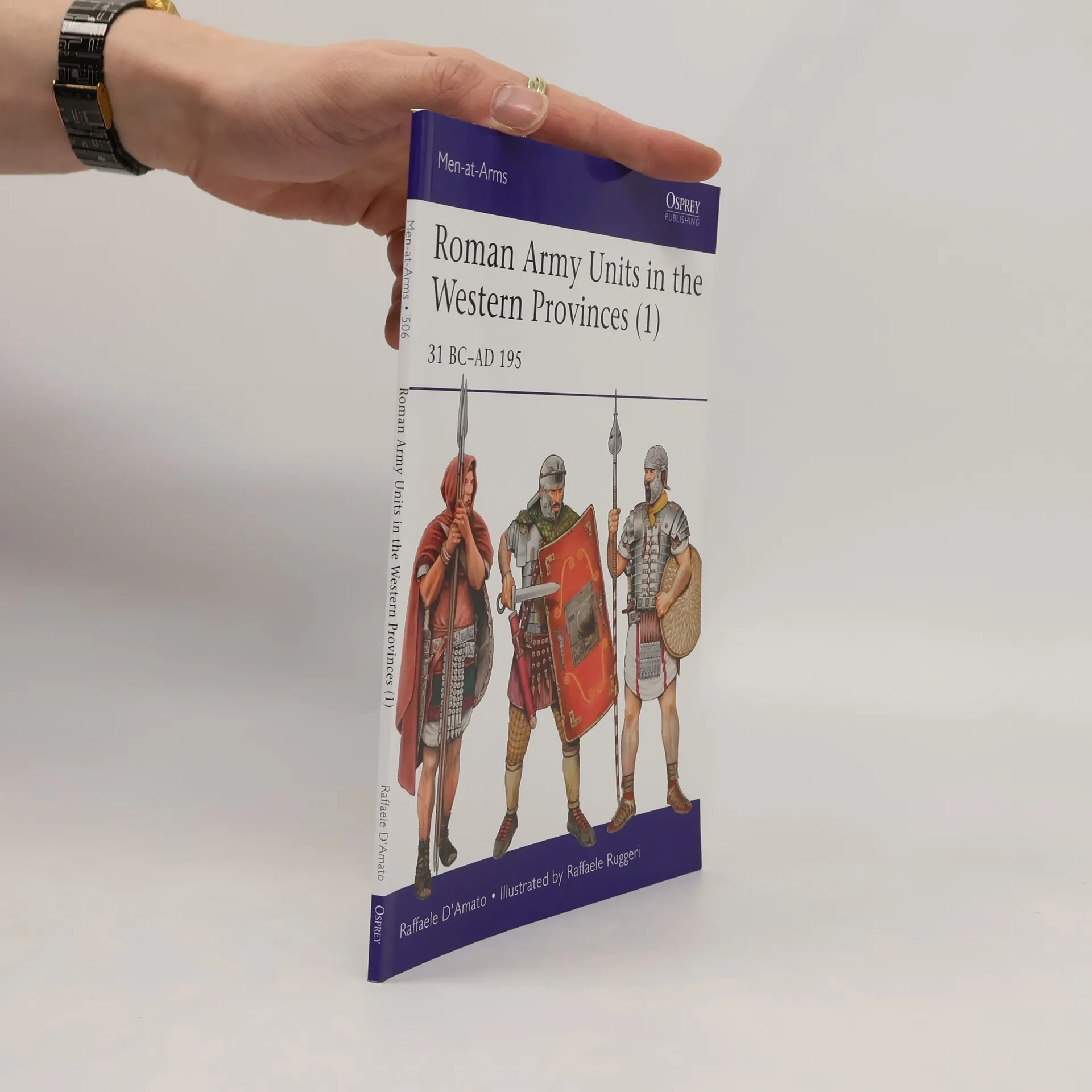
Roman Army Units in the Western Provinces 1
- 48pagine
- 2 ore di lettura
At its height the Roman Empire stretched across Europe, North Africa and the Middle East, maintained by an army of modest size but great diversity. This title investigates how Roman Army units in the Western provinces were equipped, exploring the local influences and traditions that caused the variations in attire.
- 2015
Features historical and archaeological research into the mysterious and powerful confederations of raiders who troubled the Eastern Mediterranean in the last half of the Bronze Age.
- 2011
Bronze Age Greek Warrior 1600-1100 BC
- 64pagine
- 3 ore di lettura
More than a century has passed past since German archeologist Heinrich Schliemann discovered the treasures of Bronze Age Mycenae. Through a combined study of the mythical tradition, archeological findings, and written sources, this title explores the evolution of warfare in the Bronze Age Greek world.
