

Maggiori informazioni sul libro
A collection of eleven short stories of occupied Germany where Kay Boyle has spent the last two years, introduced by a longer piece on the trial of the ""Frankfort Butcher"", Heinrich Boab. Both here, and in the stories, the ""true computation is fervently made"" that here, in the German people, is no realization of guilt, no knowledge of guilt. The stories are enormously effective, compassionate, bitter, sharpened by the understated, the unsaid,-and it is in the short story situation (rather than in the novel) that Kay Boyle is particularly gifted. There's the arson revenge of a German child against an American family; a take-off of the Amis in Cabaret, a touching tribute to a soldier, and the little boy he outfits, and a harsh scoring of the occupation's bigger brass; and The Lost and Adam's Tod give a powerful, tacit portrayal of the victims- young and old- of displacement and discrimination... If not keyed to the preferences of her more popular audience, this will carry to her earlier, discriminating following.


Acquisto del libro
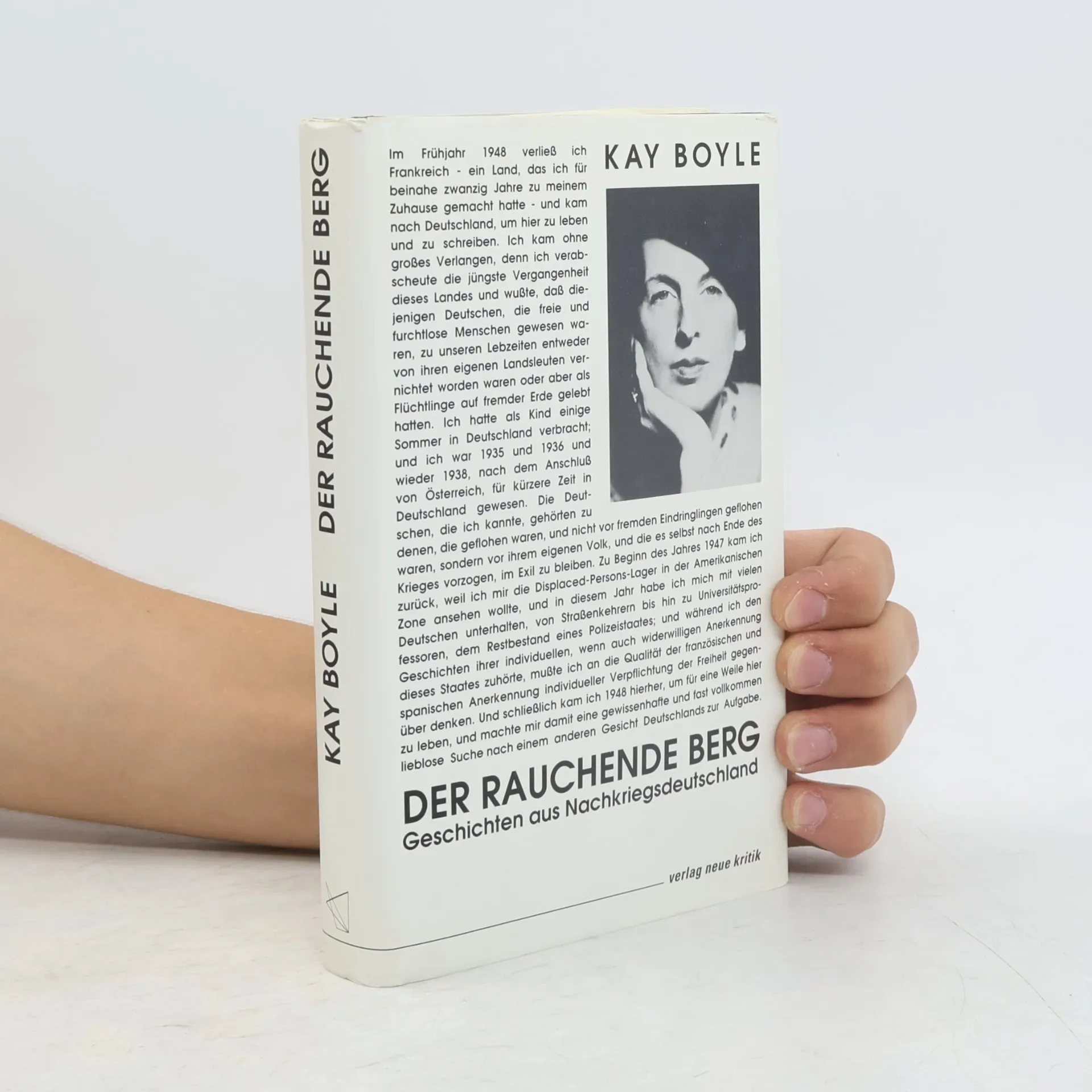
Der rauchende Berg, Kay Boyle
- Lingua

- Pubblicato
- 1991
- Rilegatura
- (Copertina rigida)
Metodi di pagamento
Qui potrebbe esserci la tua recensione.
- Titolo
- Der rauchende Berg
- Sottotitolo
- Geschichten aus Nachkriegsdeutschland
- Lingua
- Tedesco
- Autori
- Kay Boyle
- Editore
- Verlag Neue Kritik
- Pubblicato
- 1991
- Formato
- Copertina rigida
- Pagine
- 253
- ISBN10
- 3801502481
- ISBN13
- 9783801502485
- Serie
- Categoria
- Tag
- Tema stórico
- Titolo originale
- The smoking mountain
- Valutazione
- 5 su 5
- Descrizione
- A collection of eleven short stories of occupied Germany where Kay Boyle has spent the last two years, introduced by a longer piece on the trial of the ""Frankfort Butcher"", Heinrich Boab. Both here, and in the stories, the ""true computation is fervently made"" that here, in the German people, is no realization of guilt, no knowledge of guilt. The stories are enormously effective, compassionate, bitter, sharpened by the understated, the unsaid,-and it is in the short story situation (rather than in the novel) that Kay Boyle is particularly gifted. There's the arson revenge of a German child against an American family; a take-off of the Amis in Cabaret, a touching tribute to a soldier, and the little boy he outfits, and a harsh scoring of the occupation's bigger brass; and The Lost and Adam's Tod give a powerful, tacit portrayal of the victims- young and old- of displacement and discrimination... If not keyed to the preferences of her more popular audience, this will carry to her earlier, discriminating following.